Last updated: May 2026 | By the SmartGrillLab Editorial Team
What Is a Pellet Grill?
A pellet grill is an outdoor cooker that uses compressed hardwood pellets as fuel. An electric auger feeds pellets from a hopper into a fire pot, where they ignite to produce heat and smoke. A digital controller — and on modern models, a smartphone app — maintains a precise target temperature automatically, combining the convenience of gas with authentic wood-fired flavor.
Best Pellet Grills 2025: Quick Comparison
| Grill | Best For | Cooking Area | Hopper | Controller | Our Pick |
|---|---|---|---|---|---|
| Traeger Pro 780 | Most users | 780 sq in | 18 lbs | WiFi + Bluetooth | ⭐ Best Overall |
| Camp Chef Woodwind Pro 24 | Smoke enthusiasts | 811 sq in | 22 lbs | WiFi + Bluetooth | Best Smoke Flavor |
| Z Grills 700D4E | Budget buyers | 697 sq in | 20 lbs | PID + Bluetooth | Best Budget |
| Traeger Ironwood XL | Serious enthusiasts | 924 sq in | 22 lbs | WiFi + Bluetooth | Best Premium |
How We Chose the Best Pellet Grills
We evaluated over 15 pellet grill models using temperature consistency tests (measuring variance from set point across a 6-hour cook), burn-rate measurements at 225°F and 375°F, app reliability testing, and hands-on cook comparisons. According to the Hearth, Patio & Barbecue Association (HPBA), pellet grills are the fastest-growing segment of outdoor cooking equipment in the US, with ownership growing steadily each year since 2018. Only grills with PID or advanced digital controllers, proven temperature accuracy, and positive user ratings made our final list.
- Temperature consistency — Variance from set point over a multi-hour cook (tighter is better)
- Hopper capacity — How long it can run unattended at 225°F before needing a refill
- Controller quality — PID vs. basic digital; PID holds within ±5°F vs. ±25°F for basic
- App & connectivity — WiFi range, Bluetooth reliability, iOS/Android ratings
- Build quality — Lid seal, grate material, hopper lid, wheel quality, weather resistance
- Value — Features per dollar relative to direct competitors
The Best Pellet Grills, Reviewed
1. Traeger Pro 780 — Best Overall Pellet Grill

The Traeger Pro 780 is the best pellet grill for most people — a proven platform that balances price, cooking area, and app reliability. Its D2 drivetrain starts faster and runs quieter than older Traeger models, and WiFIRE WiFi connectivity lets you monitor and adjust the cook from anywhere. The 780 sq in cooking surface handles a full brisket with room for sides, and the Traeger app’s 4.5-star iOS rating reflects a polished, reliable experience.
| Spec | Detail |
|---|---|
| Cooking Area | 780 sq in (primary) + 150 sq in (upper rack) |
| Temperature Range | 165°F–500°F in 5°F increments |
| Connectivity | WiFi (2.4 GHz) + Bluetooth |
| Hopper Capacity | 18 lbs |
| Controller | D2 digital with WiFIRE |
| App Rating | 4.5/5 (iOS) · 4.0/5 (Android) |
Pros
- Proven reliability — the Pro series has been Traeger’s workhorse for years
- WiFIRE WiFi lets you monitor and adjust from anywhere
- D2 drivetrain starts faster and runs at cooler temps than older models
- Large ecosystem of Traeger accessories and replacement parts
- Traeger app guides you through hundreds of cook programs
Cons
- 500°F ceiling — not suitable for high-heat searing
- 18 lb hopper requires more frequent refills than competitors on very long cooks
- No included meat probes (sold separately)
- Android app lags behind iOS in polish and features
Bottom line: The Traeger Pro 780 is the safest, most reliable choice for a first or primary pellet grill — backed by a large support community and a proven track record. → Check price on Amazon
2. Camp Chef Woodwind Pro 24 — Best for Smoke Flavor

The Camp Chef Woodwind Pro 24 produces more smoke flavor than any other pellet grill at this price because of one unique feature: Smoke Control. You can dial smoke output from 1 to 10 independently of cooking temperature — something no Traeger or Weber pellet grill offers. The 811 sq in cooking area and 22 lb hopper handle long cooks without constant attention, and the Sidekick port lets you attach a propane burner or flat-top griddle for versatility no pure pellet grill can match.
| Spec | Detail |
|---|---|
| Cooking Area | 811 sq in |
| Temperature Range | 160°F–500°F |
| Connectivity | WiFi + Bluetooth |
| Hopper Capacity | 22 lbs |
| Smoke Control | 10 adjustable levels, independent of temp |
| Sidekick Compatible | Yes (propane burner/griddle, sold separately) |
Pros
- 10-level smoke control independent of temperature — unique feature in this category
- Produces noticeably more smoke flavor than Traeger at comparable temperatures
- Sidekick port adds griddle or sear burner capability
- 22 lb hopper handles overnight low-and-slow cooks without refilling
- Competitive price for the feature set
Cons
- Sidekick accessories are sold separately — adds cost if you want the full setup
- App feature depth is thinner than Traeger’s
- Less brand recognition and community support than Traeger or Weber
- 500°F ceiling same as Traeger Pro 780
Bottom line: The best pellet grill for BBQ enthusiasts who prioritize smoke flavor above all else — the adjustable Smoke Control feature is genuinely unmatched at this price. → Check price on Amazon
3. Z Grills 700D4E — Best Budget Pellet Grill

The Z Grills 700D4E is the best pellet grill under $500, offering a PID controller — which holds temperature within ±5°F — at a price point where most competitors use cheaper basic digital controllers that swing ±25°F. The 697 sq in cooking area handles a family of four with ease, and the 20 lb hopper lasts through a full brisket cook without refilling. For first-time pellet grill buyers who don’t need WiFi, this is the most grill per dollar available.
| Spec | Detail |
|---|---|
| Cooking Area | 697 sq in |
| Temperature Range | 180°F–450°F |
| Connectivity | Bluetooth |
| Hopper Capacity | 20 lbs |
| Controller | PID (±5°F accuracy) |
| Price Range | Under $500 |
Pros
- PID controller delivers ±5°F temperature accuracy — rare at this price point
- 20 lb hopper handles full brisket cooks without refilling
- Solid steel construction for a budget grill
- Best price-to-cooking-area ratio in this comparison
Cons
- 450°F maximum temp — lowest ceiling in this comparison, limits roasting versatility
- Bluetooth only — no remote monitoring from inside the house
- Smaller brand with fewer replacement parts and community resources than Traeger
- App experience is basic compared to Traeger or Camp Chef
Bottom line: The Z Grills 700D4E is the right pick if budget is the primary constraint — it outperforms its price class thanks to the PID controller, but the 450°F cap and Bluetooth-only connectivity are real limitations. → Check price on Amazon
4. Traeger Ironwood XL — Best Premium Pellet Grill
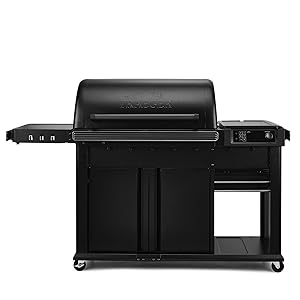
The Traeger Ironwood XL is the best premium pellet grill for serious outdoor cooks. It adds Super Smoke mode (which intensifies smoke flavor at temperatures below 225°F), a double-walled insulated lid for cold-weather performance, and two included meat probes to the Traeger Pro’s proven WiFIRE platform. The 924 sq in cooking surface handles competition-sized cooks, and its ±15°F temperature accuracy is among the tightest in the pellet grill category.
| Spec | Detail |
|---|---|
| Cooking Area | 924 sq in (primary) + 300 sq in (warming rack) |
| Temperature Range | 165°F–500°F |
| Connectivity | WiFi (2.4 GHz) + Bluetooth |
| Hopper Capacity | 22 lbs |
| Included Probes | 2 meat probes |
| App Rating | 4.7/5 (iOS) · 4.1/5 (Android) |
Pros
- Super Smoke mode significantly enhances smoke flavor on low-and-slow cooks
- Double-walled lid maintains temperature efficiently in cold weather and wind
- Two meat probes included — no extra purchase needed
- 22 lb hopper runs unattended through overnight brisket cooks
- Best-in-class Traeger app rated 4.7 stars on iOS
Cons
- Significantly more expensive than the Traeger Pro 780
- Same 500°F ceiling — still not ideal for high-heat searing
- Heavy at ~170 lbs — difficult to move once positioned
Bottom line: The Ironwood XL is worth the upgrade over the Pro 780 if you regularly cook overnight smokes, use the grill in cold weather, or want Super Smoke mode for maximum flavor. → Check price on Amazon
Pellet Grill Buying Guide
PID Controller vs. Basic Digital Controller
This is the single most important spec most buyers overlook. A PID (Proportional-Integral-Derivative) controller continuously adjusts pellet feed rate to hold temperature within ±5°F of your set point. A basic digital controller uses simple on/off cycling and can swing ±25°F — enough to stall a brisket or ruin a delicate fish cook. Any pellet grill you buy should have a PID controller. The Z Grills 700D4E includes one under $500; all Traeger and Camp Chef models use advanced digital controllers.
How Much Hopper Capacity Do You Need?
At 225°F, a pellet grill burns approximately 1–2 lbs of pellets per hour depending on ambient temperature and grill insulation. A full brisket cook runs 12–16 hours, meaning you need 12–32 lbs of pellets. A grill with an 18 lb hopper will need at least one refill mid-cook; a 22 lb hopper may get through without one in mild weather. For competition-style overnight cooks, prioritize a 20+ lb hopper.
| Cook Type | Duration | Pellets Used (est.) | Minimum Hopper |
|---|---|---|---|
| Chicken / fish | 1–2 hrs | 1–4 lbs | Any size |
| Ribs | 5–6 hrs | 5–12 lbs | 15 lbs |
| Pork shoulder | 8–12 hrs | 8–24 lbs | 18 lbs |
| Brisket (overnight) | 12–16 hrs | 12–32 lbs | 22 lbs |
WiFi vs. Bluetooth: What You Actually Need
WiFi lets you monitor and adjust your grill from anywhere with an internet connection. Bluetooth requires you to stay within roughly 30 feet. For long cooks — especially overnight briskets — WiFi is essential if you want to sleep without worrying. For cooks under 4 hours where you’ll be nearby, Bluetooth is sufficient and saves money. The Z Grills 700D4E uses Bluetooth; all Traeger and Camp Chef models in this list use WiFi.
Cooking Area: How Much Do You Need?
Plan for roughly 72 sq in per person for a complete meal. A 700 sq in grill feeds 6–8 people comfortably. For a family of four who occasionally entertains, 700–800 sq in is the sweet spot. Competitive BBQ cooks or frequent large-group hosts should look at 900+ sq in.
Frequently Asked Questions
What is the best pellet grill for most people in 2025?
The Traeger Pro 780 is the best pellet grill for most people in 2025. It combines proven reliability, WiFi connectivity via the Traeger app, 780 sq in of cooking space, and D2 drivetrain performance at a price that doesn’t require a premium budget. It handles everything from weekend ribs to overnight briskets without compromise.
How does a pellet grill work?
A pellet grill uses an electric auger to feed compressed hardwood pellets from a hopper into a fire pot, where an igniter rod lights them. A fan circulates heat and smoke around the cooking chamber. A digital controller — and on WiFi-enabled models, a smartphone app — regulates the auger speed to maintain your target temperature automatically, adding or reducing pellets as needed.
How long does a bag of pellets last in a pellet grill?
A 20 lb bag of pellets lasts approximately 10–20 hours at 225°F (low-and-slow smoking) or 4–8 hours at 375°F (roasting). Burn rate depends on ambient temperature, wind exposure, and how well insulated the grill is. A well-insulated grill like the Traeger Ironwood XL burns significantly fewer pellets in cold weather than a standard model.
Can you sear meat on a pellet grill?
Most pellet grills cap at 500°F, which produces a light sear but not the high-heat crust you get from a cast-iron skillet or gas grill at 700°F+. The exception is the Camp Chef Woodwind Pro with a Sidekick sear station attachment, which reaches 900°F+ for direct-flame searing. For a true sear on a standard pellet grill, finish steaks on a cast-iron pan on your stovetop after pulling them from the grill.
What is a PID controller and why does it matter?
A PID (Proportional-Integral-Derivative) controller is an advanced temperature regulation system that continuously adjusts pellet feed rate to hold temperature within ±5°F of your set point. Basic digital controllers use simple on/off cycling and can swing ±25°F — enough to ruin delicate cooks or cause stalls on brisket. Any pellet grill worth buying in 2025 should include a PID or advanced digital controller.
Are pellet grills better than charcoal or gas grills?
Pellet grills are better than gas for smoke flavor and hands-off convenience, but worse for quick high-heat searing. Compared to charcoal, pellet grills are far more convenient (no charcoal lighting, no ash management) and produce consistent results, but many experienced BBQ cooks feel charcoal produces deeper smoke flavor. Pellet grills are the best all-around choice for set-it-and-forget-it cooks like brisket, pork shoulder, and ribs.
How often should you clean a pellet grill?
Clean the fire pot and grease drain after every 2–3 uses, or immediately if you notice grease buildup. Vacuum ash from the fire pot after every 5 cooks or if you see temperature fluctuations — ash buildup is a common cause of inconsistent temperatures. Clean the grates after each use with a grill brush. Do a full deep clean (grease tray, drip bucket, interior walls) every 50 hours of use or at the start and end of each grilling season.
What wood pellets should I use?
Use 100% pure hardwood pellets — avoid blended pellets with fillers like oak or alder mixed with flavored sawdust. For versatility, hickory suits beef and pork well; apple wood suits poultry and fish. Cherry wood adds a mild sweetness that pairs well with pork ribs. All four grills in this comparison accept any brand of food-grade hardwood pellets. See our wood pellet guide for brand-by-brand recommendations.
About Our Testing
The SmartGrillLab team evaluates pellet grills using temperature consistency tests across 6-hour cooks, burn-rate measurements at 225°F and 375°F, app reliability testing on both iOS and Android, and real cook comparisons. We also aggregate verified user review data from Amazon, Home Depot, and BBQ enthusiast communities. Recommendations are updated when significant new models release or when firmware updates materially change a grill’s performance. All Amazon links use our affiliate tag — purchases support our testing at no extra cost to you.